
Beyond the Benchmark: Understanding Tracking Error in Long/Short Investing
Tax-Aware Portfolio Risk and Performance
In investing, certain phrases take on a life of their own. One of the most misunderstood is tracking error. Much like turbulence on a flight, it’s often assumed to be something to avoid at all costs. But just as turbulence doesn’t determine whether you arrive safely—or ahead of schedule—tracking error alone doesn’t define whether a portfolio is well-designed.
In reality, thoughtful portfolio construction requires understanding why tracking error exists, where it comes from, and whether it is working for—or against—your long-term goals.
Not All Tracking Error Is Created Equal
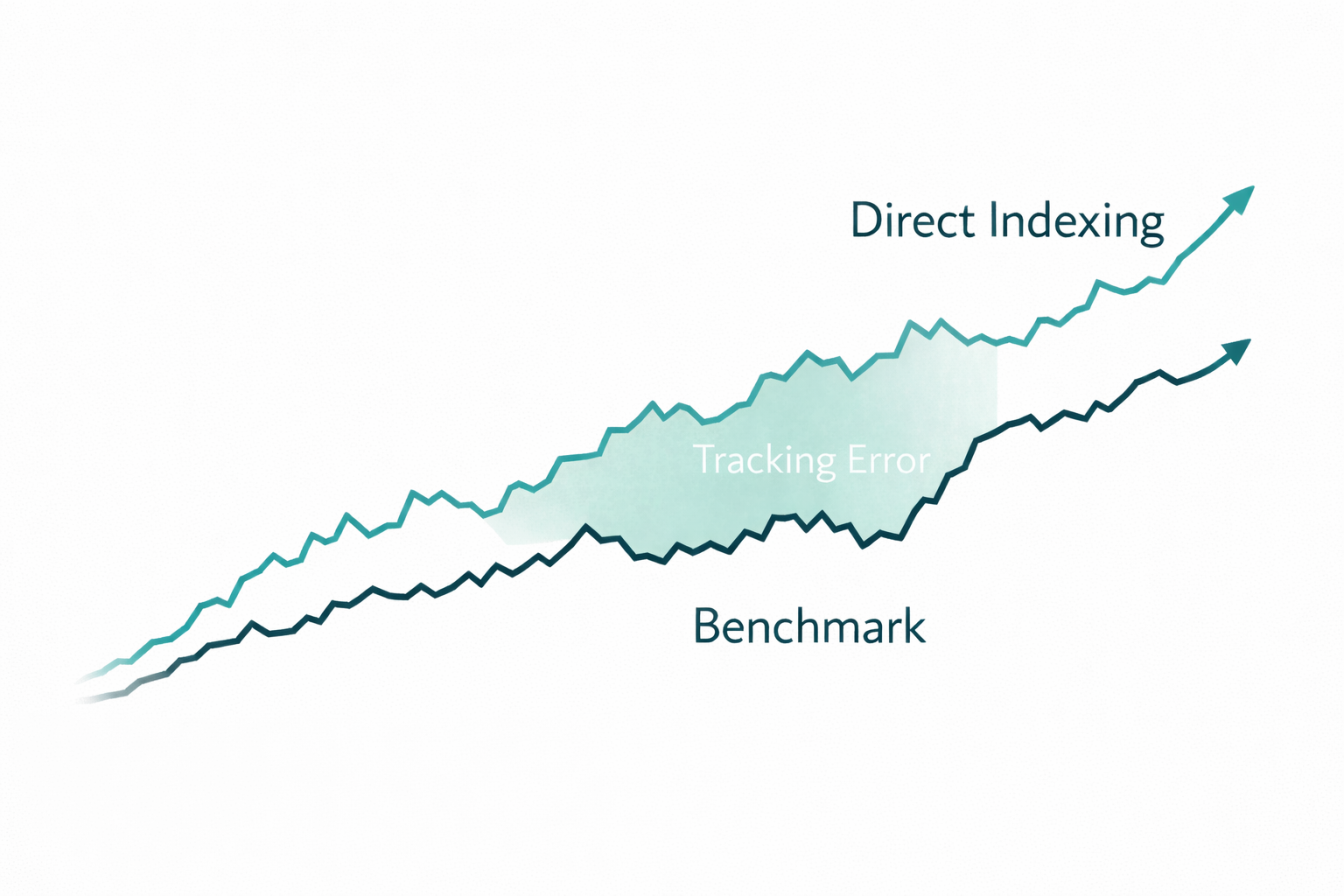
Think of tracking error as deviation from a benchmark’s path. Two portfolios may deviate by the same amount, yet for entirely different reasons and with very different outcomes.
Some deviation is incidental—an unavoidable byproduct of implementation. Other deviation is intentional—taken with purpose and expectation of reward. The distinction matters.
At Earner Wealth, we separate tracking error into two categories:
Unrewarded tracking error: deviation that exists without an expectation of higher returns
Rewarded tracking error: deviation taken deliberately in pursuit of alpha, risk management, or tax efficiency
Avoiding all tracking error may feel conservative, but it often means giving up opportunities to improve outcomes—especially after taxes.
Direct Indexing: Precision With Purpose
Direct indexing is designed to closely replicate a benchmark’s market exposure while improving tax efficiency through systematic tax-loss harvesting. Any tracking error in these portfolios is largely mechanical, driven by the timing of realized losses rather than security selection views.
Importantly, this form of tracking error is not intended to generate pre-tax outperformance. Its value shows up aftertaxes. Because the deviation does not carry an expectation of excess return on its own, skilled managers work to keep it tightly controlled.
In this context, minimizing uncompensated risk is a feature, not a limitation.
Long/Short Investing: Intentional Deviation
Tax-aware long/short strategies operate very differently.
Here, tracking error is not a byproduct—it is a design choice. Managers actively express conviction by owning securities they believe are attractively priced while shorting those they believe are overvalued. The resulting deviation from the benchmark reflects purposeful decisions made in pursuit of alpha, risk reduction, or both.
This form of tracking error is rewarded by design. It exists because the strategy is structured to outperform, manage downside, or provide diversification that traditional long-only portfolios cannot.
Critically, these strategies would accept similar levels of tracking error even if taxes were not a consideration. Tax efficiency enhances outcomes—but it is not the reason the deviation exists.
The Bigger Picture: Portfolio Intelligence
The most sophisticated portfolios are not built by eliminating tracking error. They are built by understanding it.
Just as a well-engineered system uses controlled variation to improve performance, effective investment strategies distinguish between risk worth taking and risk that simply adds noise. Long/short investing, when thoughtfully implemented alongside tax-aware tools like direct indexing, allows investors to pursue better after-tax outcomes without relying on blunt market exposure alone.
At Earner Wealth, long/short investing is one expression of a broader philosophy: intentional risk, institutional discipline, and portfolios designed for real-world investors—not just benchmarks.
Because progress doesn’t come from staying perfectly in line—it comes from moving intelligently ahead.
Disclosure
This material is for informational purposes only and does not constitute investment, tax, or legal advice. Long/short strategies involve additional risks, including leverage risk, short-sale risk, and the potential for increased volatility. Past performance is not indicative of future results. Tax outcomes depend on individual circumstances and applicable tax laws, which may change. Investors should consult their tax and legal advisors before implementing any strategy. Investment strategies may not be suitable for all investors and require minimum asset levels and appropriate account structures.