
The Gold Standard for Tax-Smart Investing
Overview
For high-net-worth investors, taxes—not market volatility—are often the single largest drag on long-term wealth.
Capital gains triggered by real estate sales, business exits, portfolio rebalancing, or the diversification of concentrated stock positions can materially reduce after-tax outcomes. While traditional tax-loss harvesting has become a widely accepted planning tool, its effectiveness is often constrained by market conditions and time.
Long/short direct indexing represents a meaningful evolution in tax-smart investing.
When implemented correctly, it allows investors to:
Remain fully invested
Preserve gains
Generate a consistent and renewable source of tax losses
Offset capital gains from real estate, business sales, and concentrated low-basis positions
Improve after-tax outcomes across a wide range of market environments
At Earner Wealth, we view long/short direct indexing as the gold standard for investors seeking to compound wealth with less interference from taxes.
Why Tax Efficiency Matters More Than Ever
Taxes are rarely optional—and rarely well timed.
For many investors, the largest tax bills arise not from poor planning, but from success:
Appreciated real estate is sold
A business exit creates liquidity
Stock compensation or legacy holdings become overly concentrated
Portfolios need to be rebalanced after strong market performance
Too often, investors are forced to choose between diversification and tax efficiency. Long/short direct indexing is designed to eliminate that trade-off.
The Limits of Traditional Tax-Loss Harvesting
Traditional tax-loss harvesting can be effective, but it is highly dependent on market conditions. Investors commonly encounter three structural limitations:
Slow Diversification of Concentrated Positions
When a low-basis holding dominates a portfolio, traditional harvesting may not generate losses quickly enough to offset gains—especially during rising markets.
Ossified Portfolios Over Time
As losses are harvested, portfolios can become dominated by low-basis positions, reducing future flexibility when tax needs arise.
Fewer Opportunities During Broad Market Rallies
When markets rise together and dispersion is low, traditional harvesting strategies often struggle to generate meaningful losses.
These constraints can leave investors exposed precisely when tax planning matters most.
Long/Short Direct Indexing: A Structural Advantage
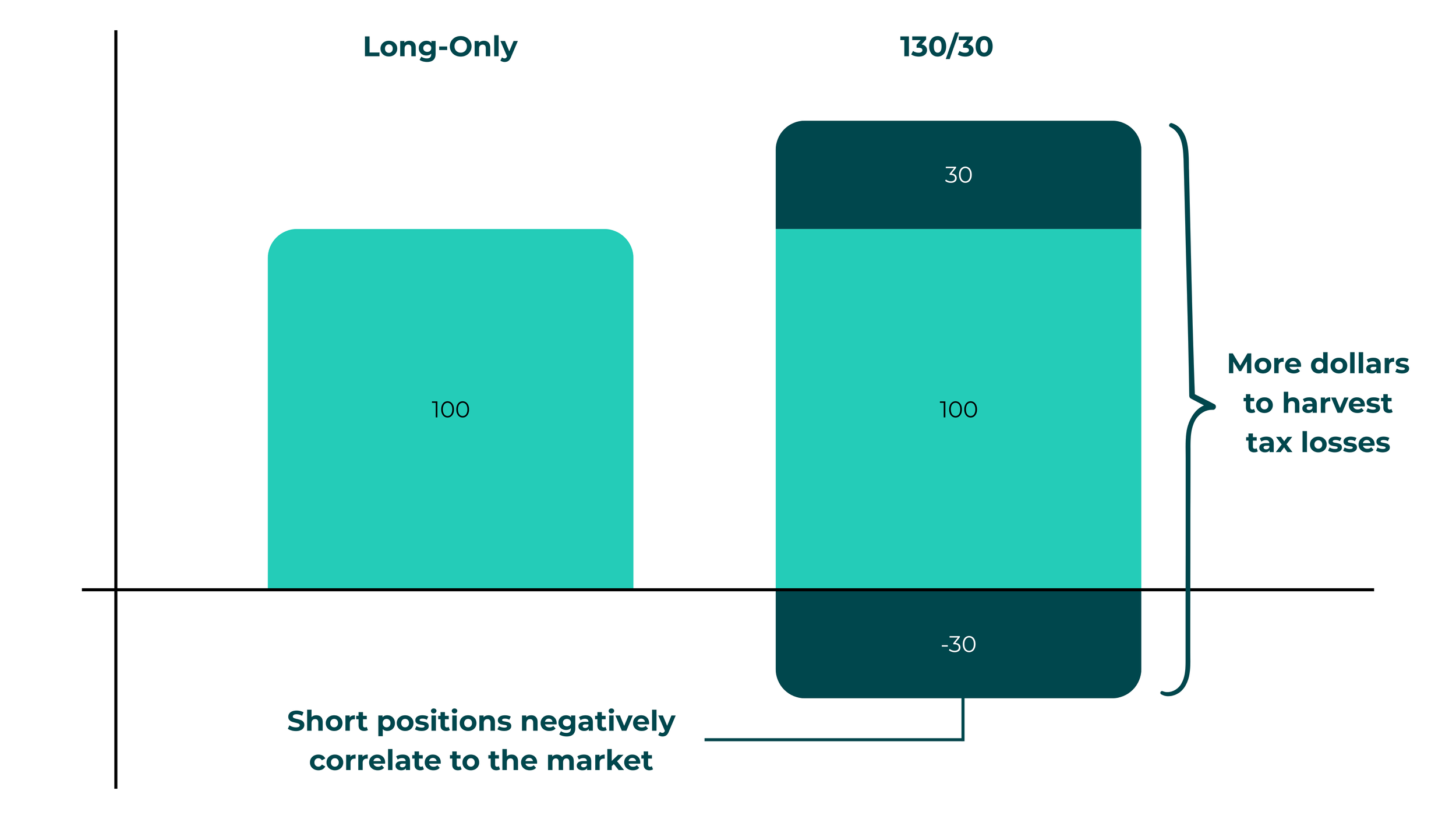
Long/short direct indexing introduces an important structural enhancement by pairing long exposure with a strategically managed short portfolio.
A commonly used framework is a 130/30 structure:
130% allocated to long positions
30% allocated to short positions
Approximately 100% net market exposure
This approach maintains market participation while dramatically improving tax-management flexibility.
*These do not represent actual investment results, either historical or projected, of any portfolio or aggregated portfolios. Actual results will vary.
This structure creates two powerful benefits:
More dollars available for harvesting
Increased notional exposure means more opportunities to generate losses without increasing overall market risk.Loss generation even in rising markets
Short positions are negatively correlated to the market, allowing losses to be harvested even when equities broadly rise.
The result is a portfolio that is less dependent on market drawdowns to deliver tax benefits.
A More Durable Source of Tax Alpha
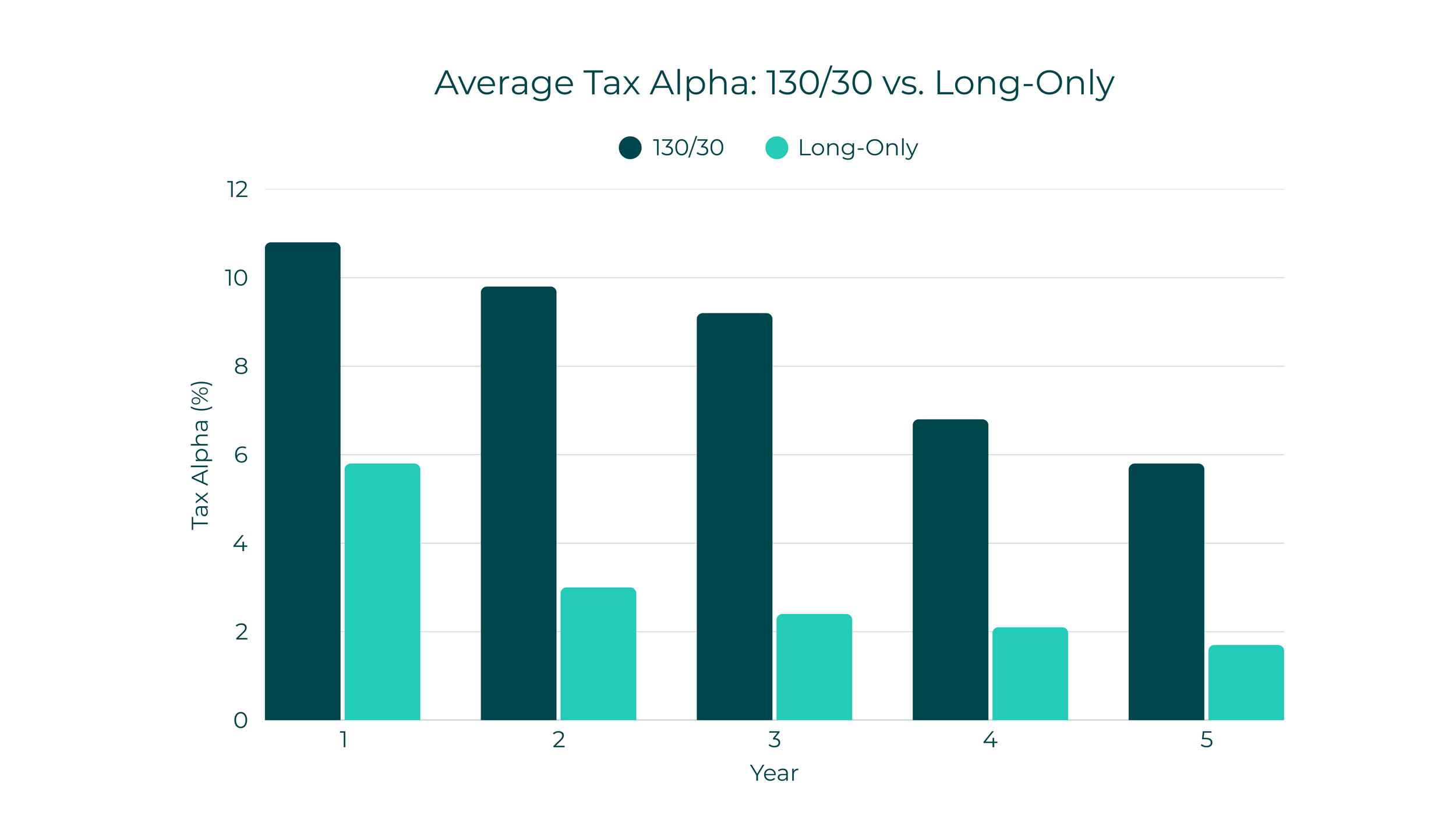
Unlike traditional long-only strategies, long/short direct indexing tends to generate more consistent tax alpha over time.
Rather than front-loading benefits that fade as portfolios mature, this approach creates a renewable source of tax assets that can be deployed when needed.
*These do not represent actual investment results, either historical or projected, of any portfolio or aggregated portfolios. Actual results will vary.
Real-World Applications
Offsetting Real Estate Capital Gains
Losses harvested within a long/short portfolio can be used to directly offset gains from property sales, helping preserve after-tax proceeds.
Business Sales & Liquidity Events
For business owners approaching an exit, proactively generating capital losses before a transaction closes can materially improve after-tax outcomes.
Diversifying Concentrated, Low-Basis Positions
Executives and founders can reduce concentration risk more efficiently—without waiting years for traditional losses to accumulate.
Why Experience Matters
Long/short direct indexing is not a mechanical strategy.
Successful implementation requires:
Disciplined security selection
Robust risk management
Daily monitoring of exposures, borrow costs, and execution
Institutional-grade operational infrastructure
At Earner Wealth, we specialize in designing and overseeing these strategies with a singular focus: after-tax outcomes.
Conclusion
Long/short direct indexing is not about taking more risk—it is about using structure, discipline, and expertise to invest more intelligently.
For investors seeking to preserve wealth, remain diversified, and minimize the long-term drag of taxes, it represents a powerful next step beyond traditional approaches.
Disclosure
This material is for informational purposes only and does not constitute investment, tax, or legal advice. Long/short strategies involve additional risks, including leverage risk, short-sale risk, and the potential for increased volatility. Past performance is not indicative of future results. Tax outcomes depend on individual circumstances and applicable tax laws, which may change. Investors should consult their tax and legal advisors before implementing any strategy. Investment strategies may not be suitable for all investors and require minimum asset levels and appropriate account structures.